The Philadelphia Chromosome: the Birth of Molecular Diagnosis
How one abnormal chromosome in leukaemia led to the first targeted cancer therapy, and defined how molecular diagnostics guides treatment today.
A milestone that shaped modern molecular diagnostics, where finding the exact genetic change points directly to the right treatment.
What happened
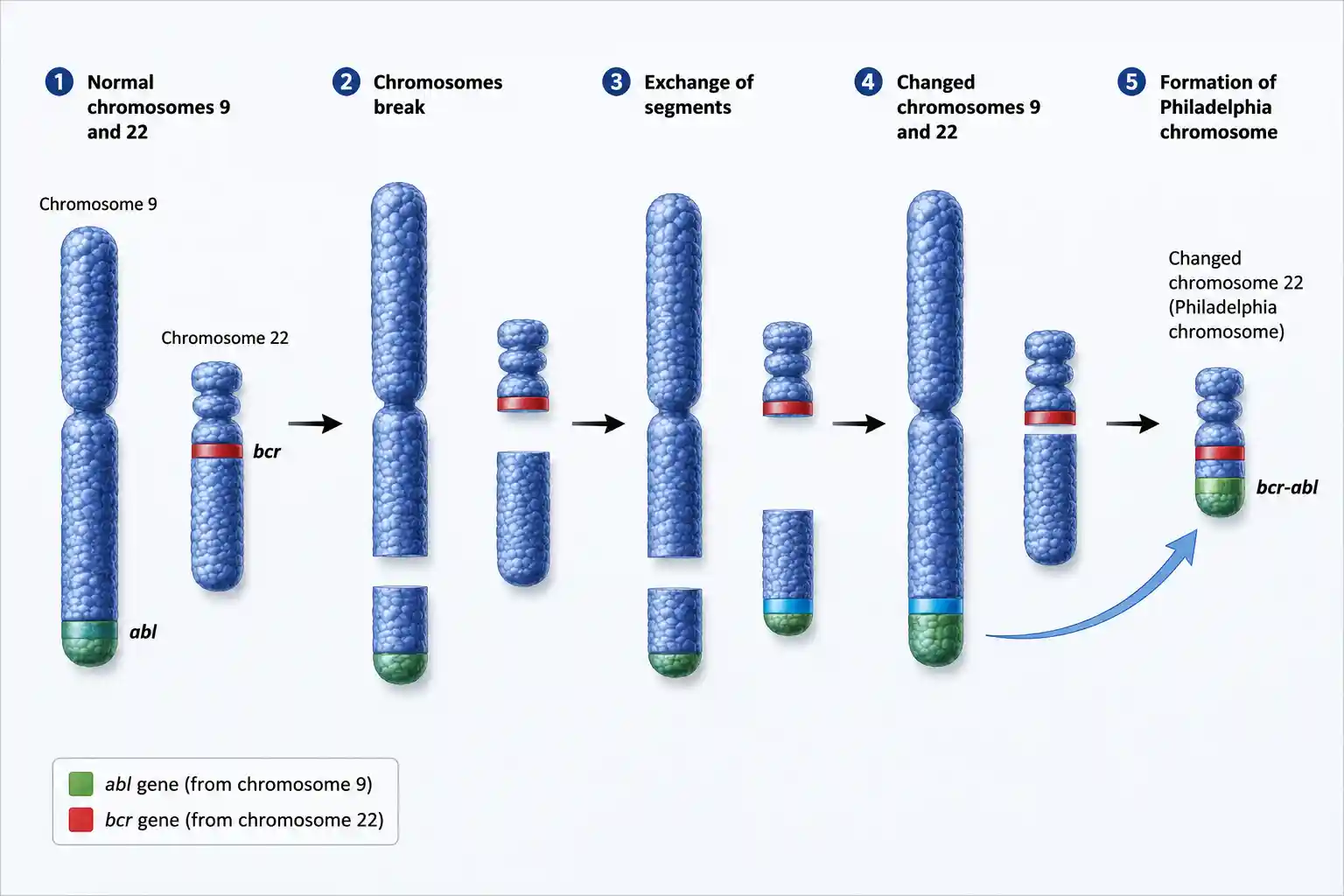
In 1960, Peter Nowell and David Hungerford spotted an unusually small chromosome in the cells of patients with chronic myeloid leukaemia (CML), later named the “Philadelphia chromosome.” It forms when pieces of chromosomes 9 and 22 swap places, fusing two genes into one abnormal gene, BCR-ABL1, that drives the leukaemia. In 2001, the drug imatinib, designed to switch off exactly that abnormal protein, produced dramatic responses (Druker et al.).
Why it mattered
For the first time, a cancer could be treated by targeting the precise molecular fault that caused it, rather than with chemotherapy alone. It set the template that modern molecular diagnostics follows: identify the specific genetic change, match it to a targeted therapy, and use molecular testing to monitor how well treatment is working over time.
Key points
- CML is defined by the Philadelphia chromosome, a swap between chromosomes 9 and 22
- The swap creates the BCR-ABL1 fusion gene, which drives the disease
- Imatinib, a targeted drug, switches off the abnormal BCR-ABL protein
- Molecular testing is used both to diagnose and to monitor response over time
How this connects to our testing
PathMole’s molecular department is built on this same principle, detecting specific molecular targets to support diagnosis. This particular test (BCR-ABL / Philadelphia chromosome) is not part of our current test menu; it is included here purely as an educational milestone. For the tests we do offer, see the Test List, or contact the lab.
Sources
Nowell PC, Hungerford DA: description of the minute (“Philadelphia”) chromosome in chronic myeloid leukaemia, 1960. · Druker BJ et al.: imatinib in chronic myeloid leukaemia; New England Journal of Medicine, 2001. See also our explainer on the WHO Classification of Tumours.
Keep reading
Related department: Molecular Diagnostics
Refer a case or start a conversation
Tell us what you need, our team will help with sample requirements, turnaround, and reporting.